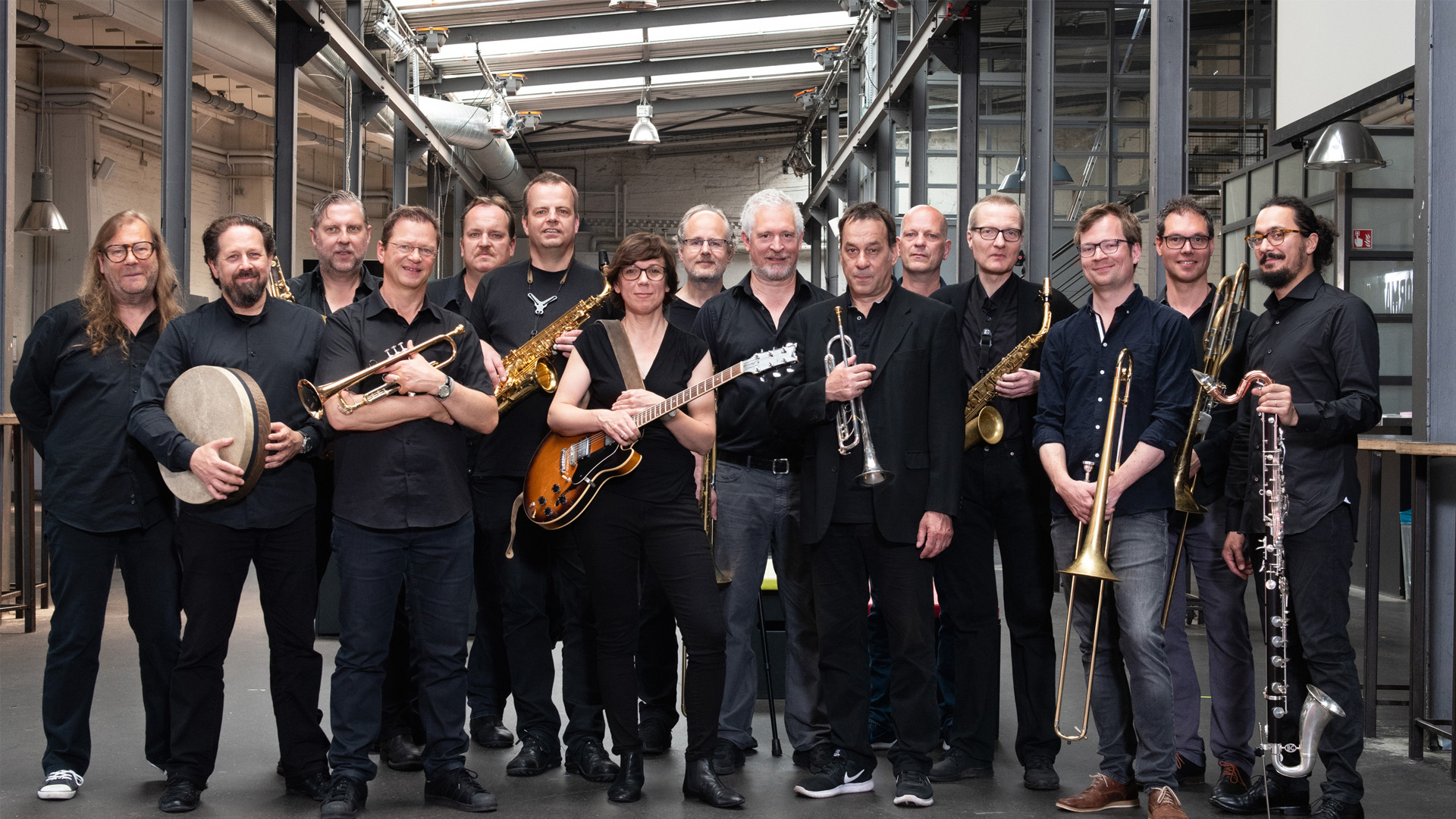
Experience the NDR Bigband's live performance with top jazz legends like Chet Baker, Gary Burton, and Joe Pass. A stunning European jazz showcase. Buy and listen now!
Experience the NDR Bigband's live performance with top jazz legends like Chet Baker, Gary Burton, and Joe Pass. A stunning European jazz showcase.
Artists:
Christof Lauer, Heinz Sauer, NDR Bigband
Format:
CD
Instrumentation:
Big Band & Ensembles
Credits
Line-Up:
NDR Bigband conducted by Dieter Glawischnig
except #3 - Rob Pronk, #8 - Jiggs Wigham, #12 - Michael Gibbs
with Gary Burton, Chet Baker, Herb Geller, Johnny Griffin, Howard Johnson, Christof Lauer, Albert Mangelsdorff, Joe Pass, Heinz Sauer, Wolfgang Schlüter, Stan Tracey
Recording Details:
Recorded "live" at NDR Studio 10, Hamburg, Germany
except # 4, 7 and 9 at Fabrik Hamburg
Recording Engineer: Michael Plötz, Sönke Hennings, Hannes Carstens
Produced by Wolfgang Kunert with Axel Dürr and Kurt Giese
Manufacturer Info:
ACT Music + Vision GmbH & CO. KG
Hardenbergstraße 9
D-10623 Berlin
Manufacturer information
ACT Music + Vision GmbH & Co.KG Hardenbergstr. 9
D-10623 Berlin
Nguyên Lê - celebrating The Dark Side Of The MoonCD / digital
Nguyên Lê electric guitar, electronics Youn Sun Nah vocals Gary Husband drums Jürgen Attig electric fretless bass NDR Bigband conducted by Jörg Achim Keller NDR Bigband:Conductor: Jörg Achim Keller Trumpets: Thorsten Benkenstein, Benny Brown, Ingolf Burkhardt, Claus Stötter (solo on 12) & Reiner Winterschladen Saxophones / reeds: Fiete Felsch (alto & flute / solo on 11), Peter Bolte (alto & flute), Christof Lauer (tenor & soprano / solo on 4), Lutz Büchner (tenor & soprano / solo on 14), Sebastian Gille (tenor & soprano), Marcus Bartelt (baritone & bass clarinet) Trombones: Dan Gottshall, Klaus Heidenreich, Stefan Lottermann, Ingo Lahme (tuba & bass trombone) Percussion: Marcio Doctor Piano & synths: Vladyslav Sendecki (solo on 8)March, 1973... A quartet known for its psychedelic inclinations delivered a fortress of an album: The Dark Side of The Moon was a musical UFO featuring the most advanced technology of the period, a stratospheric record which mirrored society and our errant human ways. Pink Floyd was about to write an essential chapter in rock history and enjoy planetary fame; even today, their album is still one of the greatest sellers of all time.
The idea behind a new reading of it came from ACT-director Siggi Loch and NDR producers Stefan Gerdes and Axel Dürr, whose radio Big Band is no secret for jazz fans. Their idea may have been a bold initiative, but the project implied an orchestra capable of linking tradition with today, and it looked to have every chance of succeeding because it would involve not only Michael Gibbs – composer, arranger, old friend –, but also, joining forces with them, Nguyên Lê, a guitarist known for jumping stylistic borders. The whole idea, finally, seemed a very good one indeed...
Nguyên Lê is a magician; his art reveals itself not only in his own compositions but also in his celebrations of the music of the past, where his approach to the latter resembles sculptures made of new clay. Remember Purple, his tribute to Jimi Hendrix, or more recently his Songs Of Freedom and its evocations of rock's greatest moments. He's a flamboyant guitarist and, while he shows courteous deference to his source material, he has always expressed the full diversity of an imaginary world engendered by his own history, that of a nomad, self-taught virtuoso: his music feeds on influences embracing all continents, and is painted with colours drawn from jazz, rock, and a kind of world fusion permeated with light.
Celebrating The Dark Side Of The Moon demonstrates that the imagination of Nguyên Lê has indeed risen to power; it guides us down other, more personal paths, and is inhabited by that musical "brotherhood" which has never left him all these years. It's as if the ecumenism of song was part of his creative DNA.
And it's true that for the guitarist there was never any question of locking himself away – due to respect in excess – inside the constricting framework of the Floyd's repertoire:
With its gem-like allure, it's obvious that any enterprise which consists solely of a mechanical re-reading of the record would be taking a great risk: the dangers are insipidity and an absence of soul. But Nguyên Lê is one whose aim is true – straight to the heart – and he belongs to those who've learned to let their innermost beings speak out like a passport for the emotions. For a full hour, he gives new shapes to ten compositions in dual complicity with the NDR Big Band, a seasoned formation whose warm textures, uplifted by the orchestrations of Michael Gibbs, elegantly succeed in drawing us away from the original intention of the music without betraying it in the least. Together, they strip the seminal music of its progressive clothes to dress it in another setting, that of an idiom whose dominant sensibilities, those of jazz, come to full bloom in the comfort of the orchestral motifs provided by the NDR Big Band. And it's not even a certainty that the ontological questionings which haunted the texts of Roger Waters and his comrades – money, death, old age, madness – hold much importance in this contemporary celebration.
The essential seems to lie elsewhere: in a more timeless translation of their aesthetic, and in the liberation of energies. The arrangements – three written by Gibbs himself, the others by the guitarist – provide choice settings for inspired soloists and allow other compositions to emerge as natural extensions of the original opus. Nguyên Lê's quick-tempered playing, armed with those fiery, oriental accents we've learned to love, can also safely rely on some trusted guests: Jürgen Attig, Gary Husband, or Youn Sun Nah, a purveyor of magic spells whose chalice brims with magnetic grace.
Celebrating The Dark Side Of The Moon is no simple tribute to a record which made history. It fervently expresses the re-creation – exempt from all imitation – of a score which you can hear in filigree. This is a palimpsest. The writing can still be (re)read, with warm hues forged by respect for the original matrix and the multiple expressions of its identity. Like a principle of Life. Denis Desassis Credits:
Produced by Nguyên Lê Executive Producers: Axel Dürr & Stefan Gerdes All arrangements by Nguyên Lê, except 04, 14 & 15 by Michael Gibbs Orchestrations by Michael Gibbs Recorded at NDR Bigband studio by Michael Ploetz and Wolfgang Dierks (audio technician), Hamburg, from December 2 - 6, 2013 Youn Sun Nah recorded by Nguyên Lê Recording Producer: Walter Quintus Produced and mixed by Nguyên Lê at Louxor studios, Paris Barbès, March & April 2014 Mastered by Bruno Gruel at Elektra Mastering, France The Art in Music: Cover art: “Blue Valentine” (detail, 2009) by Martin Noël (1956 - 2010), by permission of Margarete Noël
Christof Lauer - Petite FleurCD / digital
Christof Lauer soprano & tenor saxophoneHubert Nuss piano Patrice Héral drums NDR Bigband conducted by Rainer Tempel
Only very few of today's jazz musicians and fans still know who Sidney Bechet is: one of the founding fathers of jazz. He played the soprano saxophone like no other, and with his French-Creole-inspired compositions, he was a forerunner of jazz's openness to all musical styles.
More than ten years ago, ACT owner Siggi Loch, whose passion for jazz was aroused by a Bechet concert that he attended at the age of 15, asked Christof Lauer whether he could imagine doing a project that focused on this jazz pioneer. What Loch was hoping for was an entirely new way of looking at the genius of this New Orleans native, born in 1897, interpreted by someone from a free-jazz background who had developed his unmistakable sound playing with Albert Ayler and Stan Getz, collaborating with the Frankfurt School of Albert Mangelsdorff and Heinz Sauer, and working with American jazz musicians and the French avant-garde around Michel Godard and Marc Ducret.
But as Lauer recalls, he – the "best saxophonist we have in Europe" according to Volker Kriegel – was "in a totally different place at the time". But the seed was sown, and it germinated slowly but surely, as is not entirely atypical for Lauer: For example, he didn't bring out his debut album, chastely bearing only his name as a title, until 1990, at the tender age of 37, which, however, promptly won the annual German Record Critics' Award, a feat that he repeated nine years later with his ACT debut "Fragile Network". Lauer also says that he didn't have much to do with Bigband music either, until 1993, when he finally succumbed, after several requests, and joined the NDR Bigband, which he is still a member of to this day. The band director at the time, Dieter Glawischnig, who had been Lauer's teacher in Graz in the 70s, convinced him with arguments such as that the orchestra was transforming into a soloist band.
In a similar way, the collaboration had also become more intense with Rainer Tempel in recent times, one of Germany's leading bigband arrangers and composers, who also works for the NDR Bigband. It was with him that Lauer revisited the subject of Sidney Bechet, "and I found myself relating to Siggi Loch's idea as a bigband thing, because Rainer knows how I play and how you can realize a project like that. And because he always totally engrosses himself in every venture he commits to."
And that is something that cannot be overheard on the album "Petite Fleur", which they recorded in four days in the studio. Unmistakable Bechet classics appear in an entirely new light thanks to Lauer's distinctive tone and the multilayered arrangements. It all begins with the soprano saxophone, because even though most know Lauer as a tenor saxophonist: "I played an incredible amount of soprano in the HR Jazz Ensemble, and occupied myself with it intensively," he says. Sidney Bechet's typical vibrato is replaced by Lauer's intense and expressive sound, which can draw long lines just as readily as swirling garlands. "It wouldn't make any sense to copy Bechet," Lauer explains. "It's about finding out how it interacts with your own world, and what energy is borne of that."
And so Bechet's sound cosmos is given new clothes, with Lauer, Tempel and the NDR Bigband intelligently and profoundly interpreting the contrasts that lie between the lines in these catchy and emotional tunes: on standards that Bechet lent his inimitable signature to, such as Harry Barris' "Wrap Your Troubles In Dreams" and "On The Sunny Side Of The Street"; but even more so on his own famous songs from his Paris period, from the title track "Petite Fleur" to "Les Oignons" through to the Magrebinian-influenced "Casbah - Song of the Medina". Right from the intro, Tempel's mastery can be heard, letting the NDR Bigband take paths that branch off the streets of Antibes - "Dans Les Rues D'Antibes" -, only to have Lauer's saxophone artistically entice them back onto main street again. And even for Lauer, "Si Tu Vois Ma Mere" is the best proof "of the incredible power of these almost forgotten works. They are really catchy, and yet at the same time artistic."
"We tried out a lot more songs than could go onto the CD," Lauer recalls, but one surprise, Fats Waller's "Honeysuckle Rose", is on the album, and it has its own special relevance: "Early on in my career, I was supposed to play that in an old-time ensemble. I turned up at the rehearsal, played it the way I'd learned it, garnered disapproving frowns and never went there again. It didn't work at all, and now I wanted to make up for that – doing it my way." "Petite Fleur" is the best proof of how worthwhile it is to rediscover tradition from time to time, just as one recaptures one's own biography. Credits:
Recorded at Studio 1 at NDR Hamburg, 16.09. - 20.09.2013, except September recorded by Hrólfur Vagnsson at Kehreinstudio Frankfurt, 02.04.2014 NDR recording team: Recording engineer: Michael Plötz Tonmeister: Hrólfur Vagnsson Sound technician (recording): Jens Kunze Mixed by Sven Kohlwage Mastered by Klaus Scheuermann A Norddeutscher Rundfunk production, 2013 Producers for NDR: Axel Dürr & Stefan Gerdes Cover art by Imi Knoebel / ACT Art Collection